
Skip Navigation Links
Home
Sitemap
Contact Us
EngineeringPLMTechnology
Skip Navigation Links
Corporate
Software Solutions
Engineering Solutions
Technology Solutions
Industries
Investors
Media
Desktop Engineering names Geometric’s DFMPro as the Editor’s Pick of the Week.
Read More >>
 
Skip Navigation Links Home > Modules > Strip Nesting
Skip Navigation Links
Modules
Evaluation
Datasheet
FAQs
Press Releases
Case Study
  
Strip Nesting
 
This fully automatic true shape nesting software enables nesting of a variety of features.

NOTE: This is an Optional Advanced Module and needs to be licensed separately.

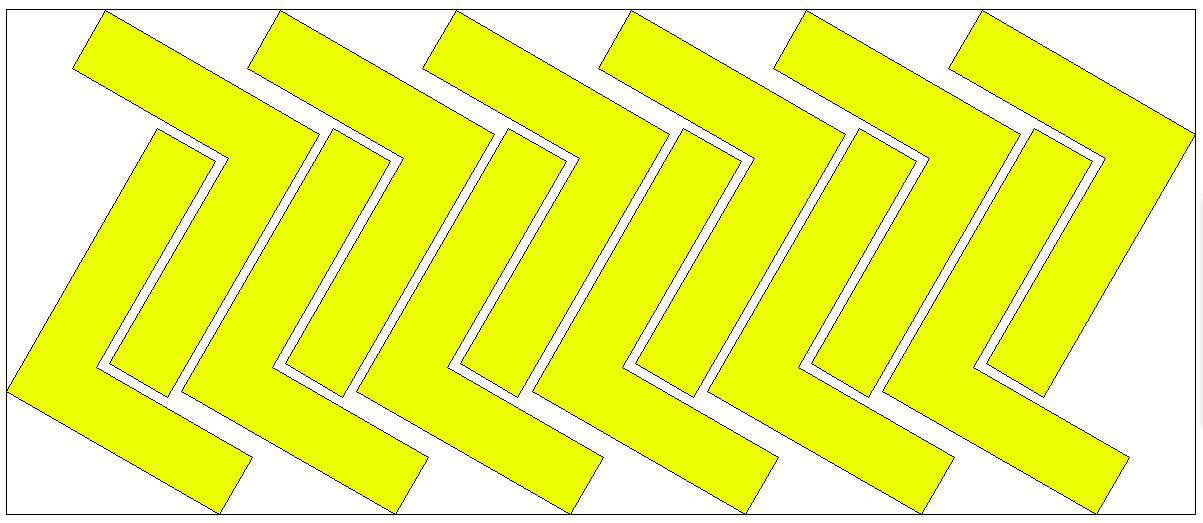
The module "strip nesting" is a specialized module for nesting the parts on a long slender strip of a fixed width. This module will be typically used where the same part type is to be fitted in a n optimal orientation on a long slender strip. Currently, Nestlib supports three kinds of combination on the strip.
 
 
Single part, single row

While nesting on a strip using this method, you can nest the same part orientation repeatedly on a long slender strip as shown in figure below. However, the vertical extents of all the part instances have to be same (single row).While nesting on a strip using this method, you can nest the same part orientation repeatedly on a long slender strip as shown in figure below. However, the vertical extents of all the part instances have to be same (single row).


Double part, single row

In this method, the part is allowed to be combined with its 180 degrees rotated counterpart or its mirror image (double part). However, the vertical extents of the part and the pair have to be the same (single row). The example of this method is as shown in the figure below.


Double part, double row

In this method, the part is allowed to be combined with its 180 degrees rotated counterpart or its mirror image (double part). The pair is then rotated through all the orientation angles and the pair giving best utilization is nested. During this procedure, the rotation angle for the part is retained. Also, the vertical extents of the part and the pair can be different (double row). The example of this method is as shown in figure below.